Drums
Not gonna lie, this is kind of addictive.
Drums is the weirder side of MIDIpad. The two sticks run the groove: left stick keeps time on the hi-hat, right stick drives the kick, and the snare backbeat kicks in when the sticks are fully pushed to their edges or by pulling R2. Underneath that, the four buttons under your right thumb put the kick in specific places and the d-pad plays the snare while the left stick is centred. Point a stick to start a rhythm. The direction picks the rhythm, and letting go stops it.
Drums sends on the MIDIpad Drums port. Out of the box it sends standard General MIDI percussion, so any GM-mapped drum kit works without you configuring anything. See Set up your DAW.
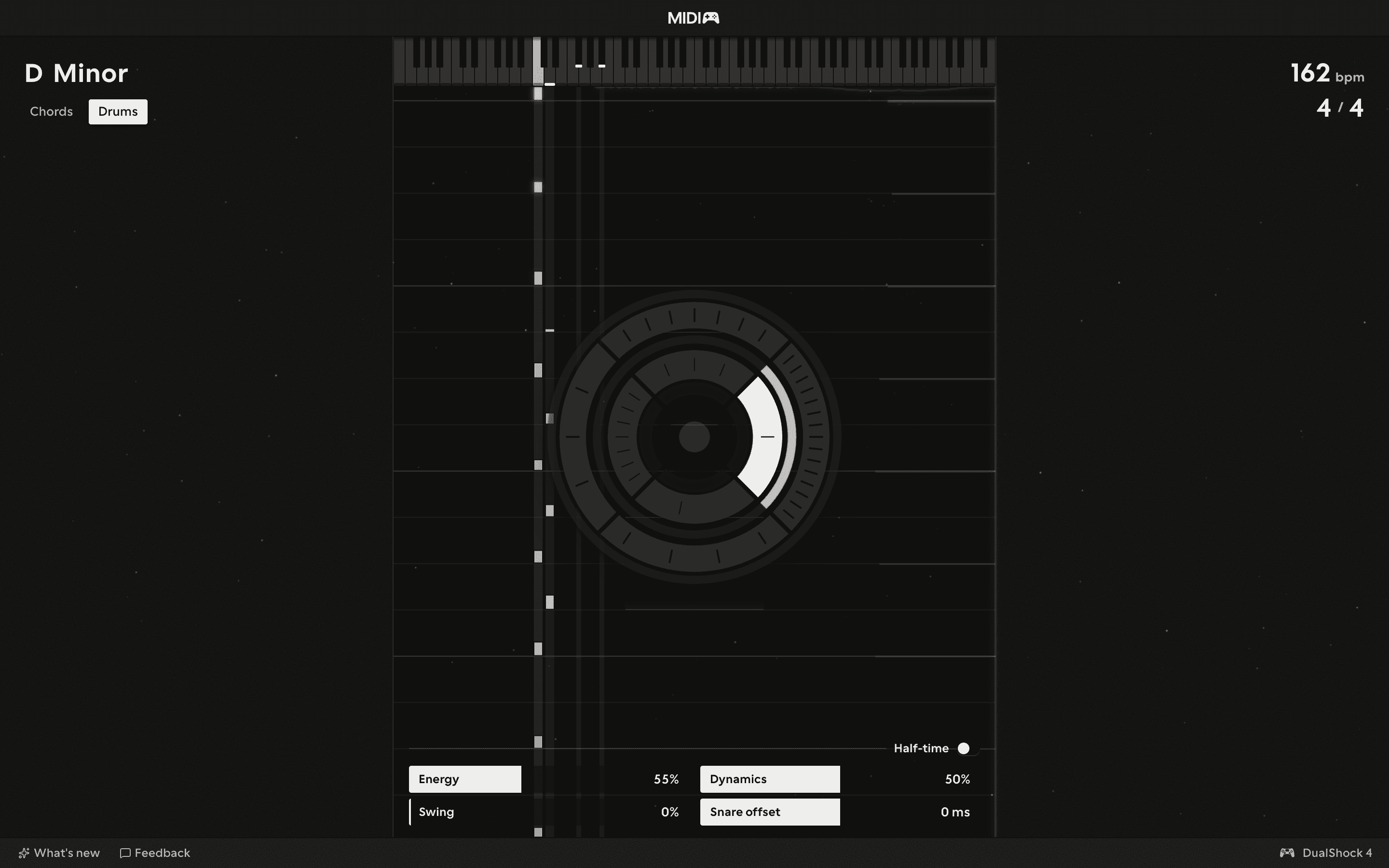
At a glance
Starts a hi-hat rhythm. The direction you point picks which one.
Starts a kick rhythm. The direction picks which one.
Push all the way out and the snare joins in on the backbeat. Or set Backbeat to Manual and it's on the right trigger instead.
Hold and it adds a hit between every pair of hi-hat hits.
Hold for a busier kick. On quarters and the two-step it plays a fill pattern. On eighths and sixteenths it doubles the rate.
Hold for half-time.
Hold to move the snare to the & of every beat, four a bar instead of two. Hold it with half-time to keep the snare on the 2 and 4 while the rest of the kit halves.
Four fixed kick placements, one per button. Press to land a kick on the next sixteenth. They follow half-time and ignore the offbeat snare. I don't recommend trying to finger drum with this.
Eight snare patterns, from ghost notes up to a continuous roll.
Hold while the hi-hat plays to open some of the hats. The deeper you pull, the more of them open.
The backbeat, when it's set to Manual
With Backbeat set to Manual in Settings, hold to play the snare on the backbeat. Either way, how far you pull it goes out as the snare's pressure and slide.
A crossfader on CC 16. Slide a finger across the pad to move it. Click the left, middle or right of the pad to jump it there.
Switch instrument
Chords or Drums.